Robinhood Chain · Uniswap v2 · 1B fixed supply
The cat that runs
a treasury.
Most memes are a picture and a promise. CashCatStrategy is a picture with a treasury behind it. A 4 percent tax on every trade buys $CASHCAT, parks it in on chain sell walls above cost, then buys back and burns its own supply with the profit. One billion tokens, no mint, liquidity burned.
0x1585fc848980b6b24b707b5e51081fa80ce61170
The treasury trades $CASHCAT, the flagship cat of Robinhood Chain, at
0x020bfC650A365f8BB26819deAAbF3E21291018b4.
$CASHCATSTR above is the strategy token you hold.
Always verify the address on chain before you buy
Live on chain
Everything, read live.
The thesis
A meme with a treasury.
The usual meme launches, pumps, and then lives off attention alone. When the timeline moves on there is nothing underneath. CashCatStrategy starts from the opposite idea. The cat is the front of house. Behind it sits an autonomous treasury that does exactly one job, forever, and every trade feeds it.
The supply is one billion and it is fixed. There is no mint function anywhere in the contract, so no one can print more later, not the team, not a future owner, not a compromised key. On top of that the token is deflationary, because the treasury keeps buying $CASHCATSTR back off the market and burning it.
Liquidity is burned to a dead address, so the floor cannot be pulled
out from under holders. Trading opens exactly once through
openTrading and can never be closed again. The max wallet
is 2 percent at launch, which keeps any single buyer from cornering the
book on day one. No pause switch, no quiet freeze.
The strategy is a loop. The tax buys $CASHCAT in small slices, the treasury sells it higher through on chain walls, and the profit both burns $CASHCATSTR and, when holders vote for it, pays $CASHCAT to voters. The principal always returns to the treasury. It is a ratchet, not a pipe. Value compounds inside, it does not leak out.
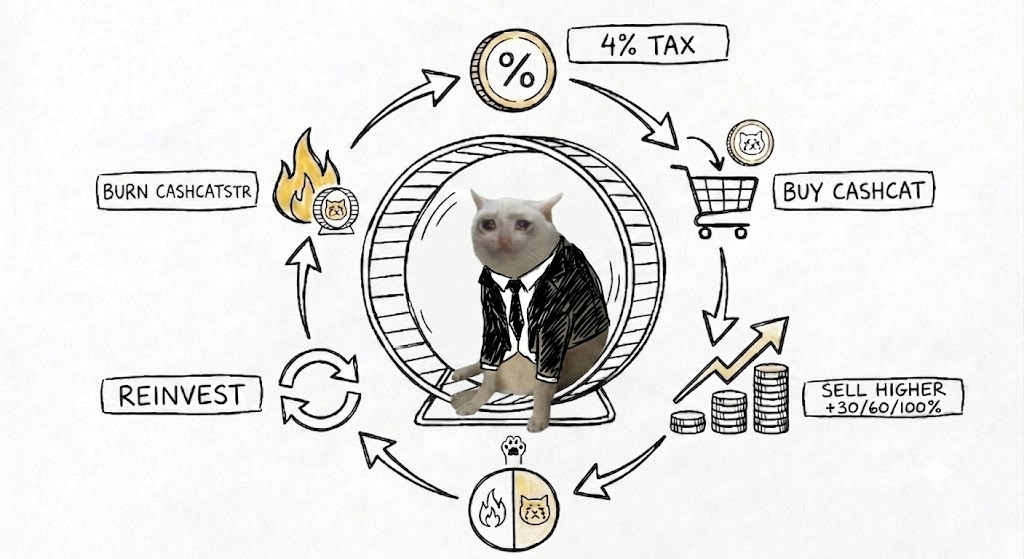
The cycle · tax buys CASHCAT, walls sell higher, profit burns the supply
The mechanism
Four moving parts.
One closed loop.
Every swap pays in
Every buy and sell of $CASHCATSTR carries a 4 percent tax. It converts to ETH and lands in an autonomous treasury. The cap is 10 percent per side and it lives in the bytecode. The owner can never push it higher.
The treasury stacks CASHCAT
The treasury uses that ETH to buy $CASHCAT, the flagship cat of Robinhood Chain, in small capped slices that never move the market. It tracks its average cost as it stacks.
Walls, not dumps
The CASHCAT is parked in Uniswap v3 sell walls placed above cost. No wall can ever sit below plus 25 percent over the average cost. A wall only fills if the price rises to it. It sells into strength, never into weakness.
Supply only goes down
Realized profit buys $CASHCATSTR back off the open market and burns it, or, when holders vote for it, pays $CASHCAT out to voters. The principal stays in the treasury and keeps working.
Governance
Holders hold the wheel.
What does the treasury do with realized profit? Each cycle, holders vote the split between buying $CASHCATSTR back and burning it, and paying a share out to voters in $CASHCAT. The community decides where the profit lands, not the team.
How does the treasury place its walls? The floor is fixed in code, no wall ever sits below plus 25 percent over cost, but holders vote on the ladder above it, how patient or how aggressive the walls should be as the treasury stacks and sells.
The airdrop
A vote that pays.
Real treasury profit
It comes from the profit the treasury books when it sells CASHCAT higher than it bought. Real gains the cat actually made, shared back with the holders who show up, not money pulled from the next round of buyers.
In $CASHCAT
The share holders vote to distribute is paid in $CASHCAT, the token the treasury already stacked and sold. It is real inventory that changed hands on chain, not freshly printed supply.
The voters
It goes to the addresses that showed up and voted. Taking part in governance is the ticket. This rewards the holders steering the treasury, not passive size alone.
Usual meme vs the cat
Attention runs out.
A treasury compounds.
| axis | usual meme | CashCatStrategy |
|---|---|---|
| Supply | Often mintable | 1B fixed, no mint, burns down |
| Liquidity | Can be pulled | Burned to a dead address |
| Trading gate | Can pause and trap | Opens once, never closes |
| Tax | Can spike anytime | 4 / 4, capped 10% per side |
| Max wallet | Silent tighten | 2% at launch |
| Value source | New buyers | Treasury profit from trading CASHCAT |
| Selling | Panic dumps | Walls that only fill into strength |
| Direction | Team decides | Holders vote the split |
Join the cat
One billion tokens.
One treasury.
Grab the contract, follow the cat on X, and watch the treasury stack, sell, and burn its own supply.